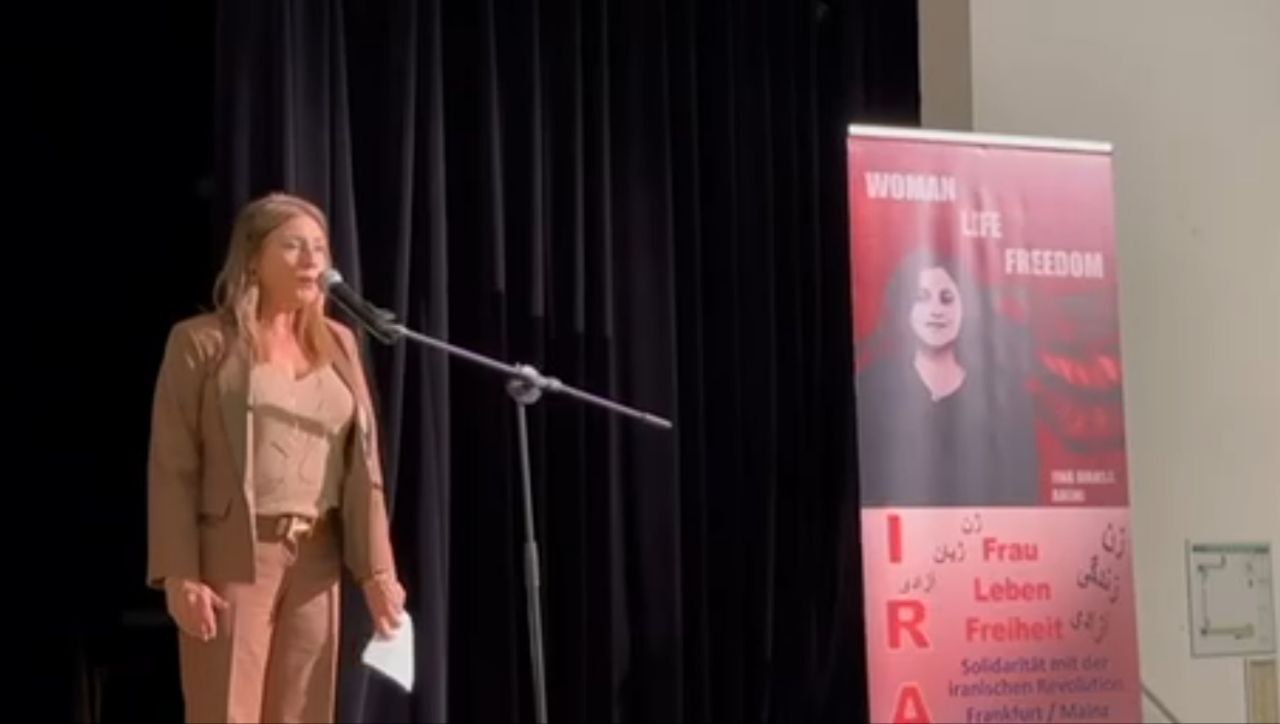
On Saturday, September 20, 2025 (29 Shahrivar 1404), the Women, Life, Freedom Association in Frankfurt, Germany, held a ceremony marking the anniversary of the state-sanctioned killing of Jina Amini and the beginning of the Women, Life, Freedom movement.
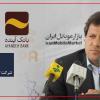
At the event, Nargess Eskandari, Mayor of Frankfurt, delivered a speech, while Hannah Neumann, a Member of the European Parliament, participated via video conference. Behrooz Asadi, a representative of the Women, Life, Freedom Association, in his speech titled “We and the Future,” emphasized the role of Iranians in the diaspora in supporting the struggles of the Iranian people. He stated: “The future of Iran is not built in distance, but in our bond with those on the ground. We must be the voice of the voiceless—in parliaments, on the streets of Europe and America, and in international institutions.”
Asadi further stressed the importance of solidarity, avoiding divisive disputes, and organizing political pressure on the Iranian government, adding: “Women, Life, Freedom does not stop at borders—it breaks them.”
The Women, Life, Freedom movement, sparked by the death of Mahsa (Jina) Amini in September 2022, has become one of Iran’s most significant protest movements in decades. Beyond opposing compulsory hijab, it has come to symbolize demands for gender equality, freedom of expression, an end to systemic repression, and broader political transformation—particularly in securing the right to self-determination for Iran’s nations.
Its impact has gone far beyond street protests, raising public awareness about women’s rights, reshaping attitudes within society, increasing pressure on the government to be held accountable, and drawing international attention to human rights conditions in Iran.
Nonetheless, the authorities have responded with brutal repression, including mass arrests, heavy security crackdowns, flogging, and even executions as tools of suppression. Yet political observers have repeatedly noted that this movement is far from over—domestic solidarity and international support continue to keep it alive.